
 By
By 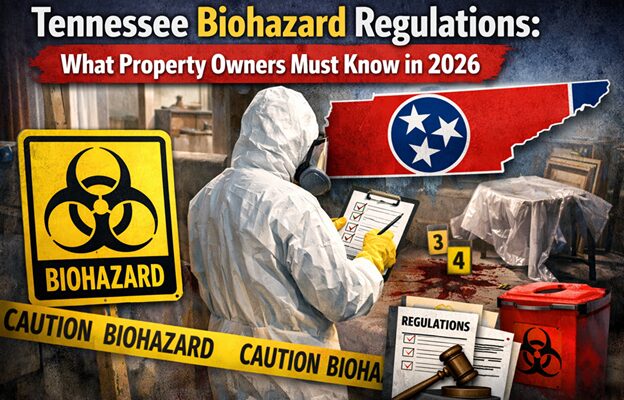
When biohazard contamination occurs on your Tennessee property—whether from crime scenes, unattended deaths, hoarding situations, or infectious disease—you’re not just dealing with an emotional crisis. You’re also navigating a complex web of state health regulations, federal OSHA standards, and serious legal liabilities that most property owners don’t discover until it’s too late.
Understanding Tennessee’s specific requirements for biohazard remediation isn’t just about compliance. It’s about protecting yourself from devastating lawsuits, insurance claim denials, and unknowingly exposing future occupants to dangerous pathogens. Professional crime scene and biohazard cleanup services throughout Tennessee have handled over 800 biohazard scenes across the state, revealing what happens when property owners make costly assumptions about cleanup requirements.
This guide breaks down exactly what Tennessee law requires, when you legally need licensed professionals, and the hidden risks that could cost you everything.
Tennessee Department of Health Biohazard Disposal Regulations
Unlike some states with vague guidelines, Tennessee has specific regulations governing biohazard waste handling and disposal that property owners must follow. These requirements fall under the Tennessee Department of Environment and Conservation (TDEC) and align with federal OSHA Bloodborne Pathogen Standards (29 CFR 1910.1030).
Key Tennessee-Specific Requirements:
Regulated Medical Waste Classification: In Tennessee, crime scene materials, blood-soaked items, and trauma cleanup debris fall under “regulated medical waste” per TDEC Rule 0400-48-01. This isn’t household trash—it requires specific packaging, labeling, transportation, and disposal at approved facilities.
Approved Disposal Facilities: Tennessee law requires biohazard waste disposal at TDEC-permitted facilities. You cannot simply bag contaminated materials and place them in regular dumpsters. Violations carry fines up to $25,000 per day under Tennessee Code Annotated § 68-212-111.
Transportation Requirements: Moving biohazard waste across Tennessee roads requires DOT compliance and proper manifests. Licensed biohazard remediation companies maintain relationships with approved disposal facilities—something individual property owners typically cannot access.
Climate Considerations: Tennessee’s high humidity (average 70-80% in summer) significantly accelerates bloodborne pathogen survival and bacterial growth. According to CDC studies, pathogens like Hepatitis B can survive in dried blood for up to seven days in humid conditions—making Tennessee’s climate particularly hazardous for delayed cleanup.
What Property Owners Are Legally Required to Do
Tennessee doesn’t mandate professional remediation for all biohazard incidents, but specific circumstances trigger legal requirements that surprise most property owners.
When Professional Remediation Is Legally Required:
Commercial Properties: Tennessee OSHA regulations (paralleling federal standards) require employers to provide biohazard cleanup by trained professionals when employee exposure is possible. If you own commercial property—office buildings, retail spaces, warehouses—DIY cleanup after a workplace incident exposes you to severe liability.
Rental Properties: Tennessee landlord-tenant law (TCA § 66-28-304) requires landlords to maintain “safe, sanitary, and fit” conditions. Court precedent has established that biohazard contamination violates this requirement. Landlords who attempt DIY cleanup and fail to achieve complete decontamination face lawsuits from tenants who subsequently fall ill.
Properties in Franklin and Williamson County: Property owners in Tennessee’s affluent markets often ask: “Do I need certified biohazard cleanup for high-value properties in Franklin?” The answer directly impacts both legal liability and property value. Professional crime scene cleanup in Franklin, Tennessee faces unique documentation requirements due to Williamson County’s competitive real estate market.
Property values in Franklin frequently exceed $500,000-$1M+, and buyers in this market demand—and increasingly require—professional remediation certificates for any property with biohazard history. Real estate attorneys serving Cool Springs, Brentwood, and Franklin now routinely request ATP (adenosine triphosphate) testing results proving complete pathogen removal. Only licensed professionals provide this documentation.
Franklin property owners lose 20-30% of sale value when disclosure reveals amateur cleanup attempts. Buyers’ attorneys have become sophisticated about biohazard remediation standards, making professional documentation practically mandatory for properties in Williamson County’s high-value markets.
Multi-Unit Dwellings: Tennessee fire marshal regulations require professional documentation for any biohazard incident affecting common areas or multiple units.
When You Can Legally Self-Remediate:
Tennessee law allows property owners to clean their own single-family, owner-occupied residences after minor biohazard incidents under specific conditions:
- The affected person is a household member (not a stranger or tenant)
- No visible blood exceeding approximately 1 square foot
- No decomposition or bodily fluids beyond blood
- Proper disposal access is arranged
- No insurance claim is being filed
Even in these limited scenarios, Tennessee doesn’t waive your liability—it just doesn’t require professionals. You remain legally responsible for complete decontamination and proper disposal.
Regional Response Challenges: Metro vs. Rural Tennessee
Tennessee’s geographic diversity creates dramatically different biohazard response realities that directly impact property owner compliance.
Rural Tennessee Response: Understanding Biohazard Cleanup in the Upper Cumberland
Property owners in rural Tennessee counties frequently search: “Who provides professional biohazard cleanup in Cookeville and surrounding areas?” The logistical challenges facing crime scene and biohazard cleanup services in Cookeville, Tennessee and the Upper Cumberland region exemplify why rural property owners face distinct compliance obstacles compared to metropolitan areas.
Cookeville serves as the regional hub for Putnam, Jackson, Cumberland, White, and Overton counties, positioned along the I-40 corridor roughly 80 miles east of Nashville. The geographic reality creates unique challenges for Tennessee property owners attempting to meet state biohazard disposal requirements.
Distance to Disposal Facilities: The nearest TDEC-approved biohazard disposal facility for Upper Cumberland residents is often 60-90 miles away. Many rural property owners don’t realize they cannot legally transport biohazard waste without DOT compliance and proper containment. A well-meaning property owner loading contaminated materials into their pickup truck for disposal violates both state and federal law.
Law Enforcement Protocol Differences: Rural Tennessee sheriff’s departments and smaller municipal police agencies often release crime scenes faster than metropolitan departments—sometimes within 2-4 hours. Property owners facing traumatic scenes receive less guidance about remediation requirements, leading to more DIY attempts and subsequent problems.
Hospital Partnership Requirements: Putnam County’s smaller healthcare facilities have limited biohazard disposal capacity. Licensed cleanup companies maintain partnerships with regional medical facilities for waste processing—relationships individual property owners cannot access.
Response Time Reality: 24/7 professional coverage in rural Tennessee requires companies to maintain strategic positioning. When biohazard incidents occur at 3 AM in rural Jackson County, property owners waiting for business hours risk pathogen spread, structural damage from bodily fluids, and increased cleanup costs as contamination penetrates subflooring and drywall.
Legal Liability: What Tennessee Courts Have Established
Tennessee case law has progressively expanded property owner liability for inadequate biohazard remediation. These precedents apply regardless of whether you hire professionals or attempt DIY cleanup.
Third-Party Illness Claims: Tennessee follows a “discovery rule” for personal injury claims related to pathogen exposure. If a future occupant, tenant, or visitor contracts illness from inadequate cleanup, the statute of limitations doesn’t begin until they discover the connection—potentially years after your remediation attempt.
Failure to Disclose: Tennessee residential property disclosure law (TCA § 66-5-201) requires sellers to disclose “material defects.” Multiple Tennessee courts have ruled that biohazard history constitutes a material defect requiring disclosure, even after professional cleanup. Failing to disclose—or disclosing DIY cleanup when buyers reasonably expect professional remediation—has resulted in rescission judgments and six-figure damage awards.
Workers’ Compensation Exposure: Tennessee property owners who allow employees, contractors, or workers to enter spaces with undisclosed biohazard contamination face workers’ compensation claims plus potential bad-faith lawsuits. The Tennessee Court of Appeals has upheld substantial punitive damages in cases where property owners knowingly concealed biohazard conditions.
Wrongful Death Liability: When family members attempt DIY cleanup and contract fatal illnesses (documented cases include Hepatitis, MRSA, and C. difficile), Tennessee courts have allowed wrongful death claims against property owners who failed to warn of risks or provide proper protective equipment.
The Hidden Cost of DIY: What Property Owners Miss
Price drives most DIY cleanup decisions. Professional biohazard remediation in Tennessee typically ranges from $1,500-$15,000+ depending on contamination extent. Property owners see cleaning supplies for $200 and make a dangerous calculation.
Here’s what DIY cleanup actually costs when things go wrong:
Structural Damage from Inadequate Remediation: Blood and bodily fluids penetrate porous materials within hours. Tennessee’s humidity accelerates this process. DIY attempts using household cleaners rarely achieve penetration into subflooring, wall cavities, and HVAC systems.
We’ve been called to Franklin properties where initial DIY attempts led to:
- $45,000 hardwood floor replacement (blood penetrated through 3/4″ oak into subfloor)
- $28,000 drywall and insulation replacement throughout a 2,500 sq ft home (decomposition fluids migrated through wall cavities)
- Complete HVAC system replacement after bodily fluid odors became permanent ($12,000-18,000)
Insurance Claim Denial: Most Tennessee property insurance policies cover biohazard cleanup under “sudden and accidental” provisions—but require documentation. DIY cleanup eliminates your ability to file claims because you’ve destroyed the scene documentation insurers require. Professional companies provide photo documentation, detailed reports, and chain-of-custody records that support insurance claims.
Health Costs: Tennessee has no tracking system for illnesses contracted during DIY cleanup, but emergency medicine physicians at Vanderbilt and UT Medical Center report regular cases of individuals exposed during amateur remediation attempts. Treatment for Hepatitis B/C, HIV exposure protocols, MRSA infections, and respiratory illness from decomposition gases runs into tens of thousands of dollars—none of which insurance covers when exposure occurred during unprotected cleanup.
Lost Property Value: Real estate agents throughout Tennessee increasingly advise sellers to disclose biohazard history with professional remediation certificates. Properties with DIY cleanup history sell for 15-25% below market in competitive markets like Franklin, Brentwood, and East Nashville. The stigma of “contaminated property with amateur cleanup” is real and quantifiable.
When Tennessee Law Requires Professional Documentation
Even when Tennessee doesn’t legally require professional remediation, several scenarios make professional documentation practically mandatory:
Insurance Claims: Filing homeowner’s or commercial property insurance claims for biohazard cleanup requires professional invoices, scope of work documentation, and completion certificates. DIY cleanup provides none of these.
Property Sales: Tennessee’s residential disclosure requirements combined with modern buyer diligence create a de facto requirement for professional cleanup documentation. Buyers’ attorneys now routinely request:
- ATP testing results showing pathogen elimination
- Air quality testing for decomposition scenes
- Professional remediation company licenses and insurance
- Disposal manifests proving legal waste handling
Probate and Estate Settlement: When biohazard incidents occur in estate properties, Tennessee probate courts increasingly require professional cleanup documentation to satisfy estate creditors and beneficiaries. DIY cleanup creates liability exposure for estate executors.
Commercial Property Re-Leasing: Commercial landlords cannot re-lease spaces after biohazard incidents without professional documentation. Tennessee commercial lease law and building codes create implied warranties of habitability that DIY cleanup cannot satisfy.
Specific Tennessee Regulations by Biohazard Type
Tennessee’s regulatory framework varies significantly based on contamination type:
Crime Scenes and Trauma: Regulated primarily by OSHA Bloodborne Pathogen Standards. Tennessee companies must maintain:
- OSHA-compliant exposure control plans
- Hepatitis B vaccination programs for technicians
- Annual bloodborne pathogen training certification
- Medical waste transporter permits (TDEC)
Unattended Deaths and Decomposition: Additional regulations under the Tennessee Department of Health communicable disease protocols when death involves an infectious disease. Medical examiner’s offices in larger counties (Davidson, Shelby, Knox) provide guidance on communicable disease risks, but rural counties often lack this resource.
Hoarding and Biohazard Accumulation: Tennessee Adult Protective Services (APS) may mandate professional cleanup when hoarding involves biohazard accumulation (human/animal waste, contaminated food, sharps). Property owners who ignore APS orders face contempt citations and potential criminal charges under Tennessee elder abuse statutes (TCA § 71-6-119).
Methamphetamine Contamination: Tennessee has specific meth lab cleanup requirements under the Meth Lab Cleanup Act (TCA § 68-212-501). Properties must be decontaminated to 0.1 μg/100 cm² by licensed remediators. County health departments maintain registries of contaminated properties—creating a permanent public record and a severe property value impact.
Infectious Disease Outbreaks: Tennessee Department of Health has authority to order professional decontamination during infectious disease outbreaks (COVID-19, tuberculosis, etc.). These orders carry force of law with criminal penalties for non-compliance.
Choosing Licensed Tennessee Biohazard Remediation Companies
Tennessee doesn’t require specific state licensing for biohazard cleanup companies, but several certifications and credentials indicate qualified professionals:
Essential Qualifications to Verify:
- OSHA Bloodborne Pathogen Training: All technicians should complete annual certification
- IICRC Bio-Recovery Technician Certification: Industry-standard training program
- Tennessee Medical Waste Transporter Permit: Required for legal disposal (verify with TDEC)
- Commercial General Liability Insurance: Minimum $2M coverage protecting property owners from contractor liability
- Disposal Facility Relationships: Confirmed partnerships with TDEC-approved facilities
- Vehicle and Equipment: Purpose-built vehicles with contained storage (not personal pickup trucks)
Red Flags Indicating Unlicensed or Unqualified Companies:
- Unwillingness to provide disposal manifests
- Using residential vehicles for biohazard transport
- Cannot provide references from Tennessee law enforcement agencies
- No proof of OSHA training
- Significantly below-market pricing (suggests cutting corners on disposal)
What Professional Remediation Actually Includes
Understanding professional biohazard cleanup scope helps property owners evaluate whether DIY attempts are remotely comparable:
Assessment and Documentation: Professional companies photograph and document the extent before beginning work. This documentation protects property owners in insurance claims, legal proceedings, and future sales.
Containment: Establishing physical barriers to prevent pathogen spread to uncontaminated areas. HEPA air filtration and negative air pressure when necessary.
PPE and Safety Protocols: OSHA-compliant personal protective equipment, including respirators, full-body suits, eye protection, and multiple glove layers. DIY attempts with household rubber gloves and dust masks provide virtually no protection.
Source Removal: Physical removal of contaminated porous materials (carpet, padding, drywall, insulation). Homeowners consistently underestimate contamination penetration depth.
Decontamination: Hospital-grade disinfectants proven effective against bloodborne pathogens. EPA-registered products are required—household bleach is insufficient for many pathogens.
Odor Elimination: Professional techniques including hydroxyl generation, ozone treatment (when appropriate), and thermal fogging. DIY attempts with store-bought odor eliminators fail for decomposition scenes.
Proper Disposal: Transportation to TDEC-approved facilities with proper manifests and chain-of-custody documentation.
Verification Testing: ATP testing, and in some cases air quality testing, providing objective proof of complete decontamination.
Restoration: Returning the property to pre-incident condition including reconstruction when structural removal was necessary.
Frequently Asked Questions: Tennessee Property Owners
Q: Does homeowner’s insurance cover biohazard cleanup in Tennessee?
Most Tennessee homeowner policies cover biohazard cleanup under “sudden and accidental” provisions, typically with $5,000-$25,000 limits. However, you must file claims promptly and provide professional documentation. DIY cleanup eliminates your ability to claim.
Q: How long can I wait before cleanup without violating Tennessee law?
Tennessee has no specific timeline requirement for private property, but practical factors create urgency: Pathogen spread accelerates in Tennessee’s humid climate within 24-48 hours. Decomposition odors become permanent after 72+ hours in structural materials. Property damage from fluids worsens hourly. Most Tennessee municipalities will cite property owners for public health nuisances if external odors or contamination become apparent.
Q: Do I have to tell buyers if I sell my Tennessee property after biohazard cleanup?
Yes. Tennessee’s residential property disclosure law requires disclosure of material defects and conditions affecting property value. Multiple Tennessee courts have ruled biohazard history requires disclosure even after professional remediation. Failure to disclose has resulted in sale rescission and damage judgments.
Q: What happens if I’m cited by Tennessee health department for improper biohazard disposal?
TDEC violations carry civil penalties up to $25,000 per day per violation. Criminal charges are possible for knowing violations. The citation becomes public record affecting property sales. You’ll also face mandatory professional cleanup at your expense under health department supervision.
Q: Can I deduct biohazard cleanup costs on my Tennessee taxes?
Potentially yes as a casualty loss, but tax law is complex and changing. Professional remediation invoices provide the documentation required for any deduction claims. DIY costs are virtually impossible to document for IRS purposes.
Q: How do I know if a Tennessee cleanup company is legitimate?
Verify TDEC medical waste transporter permits, request certificates of insurance showing minimum $2M general liability coverage, confirm IICRC Bio-Recovery Technician certifications for crew members, and ask for references from Tennessee law enforcement agencies and medical examiners’ offices. Legitimate companies provide this documentation readily.
The Bottom Line for Tennessee Property Owners
Tennessee’s regulatory environment creates a deceptive middle ground. The state doesn’t mandate professional cleanup for all scenarios, but the practical requirements—legal disposal, liability protection, insurance claims, property values—make professional remediation the only realistic option in most cases.
The scenarios where DIY cleanup makes sense are vanishingly rare: minor blood from a household member, no insurance claim, owner-occupied single-family home, with access to legal disposal. Even meeting all these criteria, you’re assuming enormous personal risk if future problems emerge.
For property owners in high-value markets like Franklin and Williamson County, professional documentation isn’t optional—it’s essential to preserving property values and avoiding legal liability. For rural Tennessee properties in areas like Cookeville and the Upper Cumberland, distance to disposal facilities and law enforcement protocol differences make professional services even more critical.
Professional crime scene and biohazard cleanup services across Tennessee provide 24/7 response with certified technicians, full insurance coverage, and relationships with TDEC-approved disposal facilities. Understanding Tennessee’s unique regulatory requirements and regional challenges is essential when biohazard contamination occurs.
When biohazard contamination occurs, you have one chance to do it right. Professional remediation companies are available 24/7 because Tennessee property owners can’t afford to wait—or to get it wrong.
Look for recommended brands like ACT Cleaners who use their own employees when cleaning biohazards to ensure compliance and quality controls.
This article provides general information about Tennessee biohazard regulations for educational purposes. It does not constitute legal or medical advice. Property owners should consult qualified attorneys and licensed remediation professionals for guidance on specific situations.










Comments