
 By
By 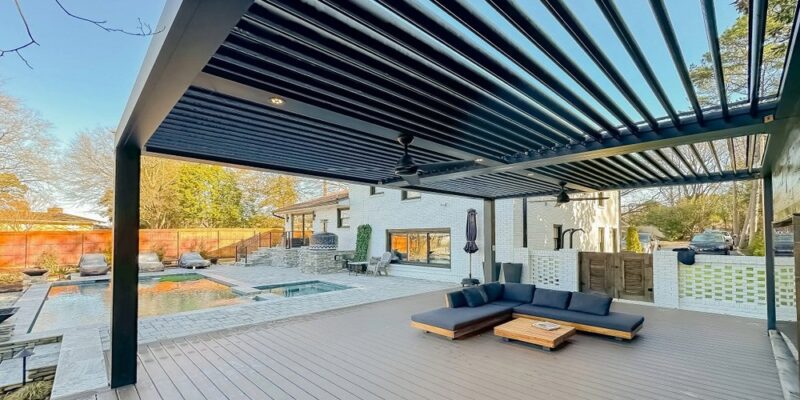
In today’s environmentally conscious world, homeowners and designers are increasingly focused on energy efficiency and comfort in outdoor living spaces. Louvered pergolas have grown in popularity due to their versatility, shade control, and aesthetic appeal. But when it comes to energy efficiency, there are key differences between manual and motorized louvered pergola systems that can influence comfort, energy use, and long‑term performance.
Let’s explore how these two systems compare in energy efficiency, comfort impact, cost implications, and real‑world performance.
What Are Louvered Pergolas?
Louvered pergolas are outdoor structures with adjustable slats (louvers) that can be tilted to control sunlight, shade, and airflow. By managing solar exposure, they can reduce heat gain on patios and adjacent interiors, helping lower cooling demands and improve comfort.
There are two primary types:
- Manual Louvered Pergolas: Louvers are adjusted by hand with a crank or lever.
- Motorized Louvered Pergolas: Louvers adjust via electric motors, often with remote controls, apps, or sensors.
While both serve the same basic purpose, they differ in operation, integration with smart systems, and ultimately energy performance.
Sunlight Control and Thermal Comfort
Manual Louvered Pergolas
Manual louvered pergolas require users to physically adjust the louvers based on conditions. This means shade adapts only when someone is present and proactive. As a result:
- Shade may not be optimized throughout the day if adjustments are infrequent.
- Heat gain may increase in peak sun hours if louvers remain improperly positioned, elevating cooling needs indoors.
- User engagement is necessary for maximum performance.
In scenarios where the pergola is used sporadically, manual systems can still provide solid shade but may miss opportunities for consistent energy savings.
Motorized Louvered Pergolas
Motorized louvered pergolas can adjust more frequently and intelligently:
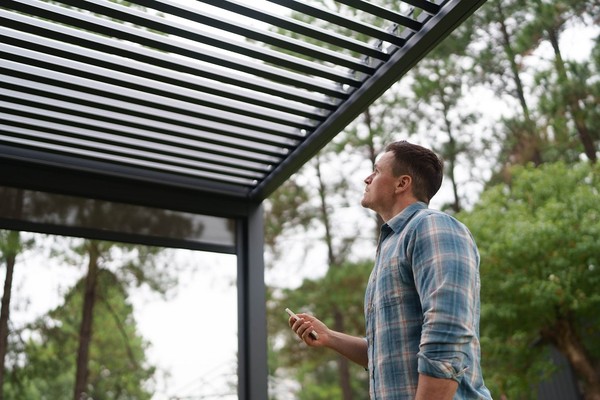
- Automated sensors (sunlight, temperature, rain) can reposition louvers in real time.
- Consistent shade is maintained without user intervention.
- Thermal comfort improves, reducing heat transfer through adjacent windows and doors.
This real‑time responsiveness often results in better performance at managing solar heat gain – a key factor in lowering energy use for cooling.
Winner: Motorized pergolas tend to provide more precise and consistent shade control, resulting in better thermal comfort and potential reductions in HVAC energy demand.
Integration with Smart Home Systems
One area where motorized pergolas outperform manual models is connectivity.
Manual Pergolas
- No automation or integration.
- Adjustment depends entirely on occupants.
Motorized Pergolas
- Can connect to smart home systems.
- Work with weather APIs, thermostats, or solar sensors.
- Adjust louvers according to time of day, weather conditions, or energy‑saving schedules.
By integrating with smart heating, cooling, and shading strategies, motorized pergolas can help reduce energy costs without requiring manual input.
Energy Consumption Considerations
It may seem counterintuitive, but motorized pergolas themselves use some energy – typically low wattage – to power motor operations. However:
- Energy used by motors is minimal compared to energy saved from reduced HVAC demand.
- Manual pergolas use no operational energy, but often underperform in shade optimization.
A motorized pergola with smart automation can actually produce net energy savings by reducing the need for air conditioning – especially in regions with intense sunlight.
User Behavior and Actual Efficiency
The real energy impact also depends on how people use their pergolas:
- A manual pergola used consistently and intelligently (adjusted throughout the day) can perform comparably to motorized systems in shade control.
- A motorized pergola that remains in default positions or has poorly calibrated sensors may deliver little benefit.
So while technology increases potential efficiency, user habits still matter.
Cost vs. Efficiency
Upfront costs also influence decisions:
|
Feature |
Manual Pergola |
Motorized Pergola |
|---|---|---|
|
Upfront Cost |
Lower |
Higher |
|
Operational Energy Use |
None |
Minimal (motors & controls) |
|
Automated Control |
No |
Yes |
|
Smart Integration |
No |
Yes |
|
Consistent Shade Optimization |
Dependent on user |
High |
|
Potential HVAC Savings |
Lower |
Higher |
Motorized systems show a higher initial investment, but potential savings through improved shade control and HVAC reduction may offset these costs over time – especially in homes with high cooling loads.
Environmental Impact
When assessing sustainability:
- Manual pergolas use zero operational energy.
- Motorized pergolas can significantly reduce energy use for cooling, lowering the overall carbon footprint of a home.
In warmer climates, the environmental benefit of lowering interior cooling energy demand often outweighs the small energy consumption of automated motors.
Final Verdict
|
Category |
Best Choice |
|---|---|
|
Maximizing Shade Efficiency |
Motorized Pergola |
|
Lowest Initial Cost |
Manual Pergola |
|
Smart Home Integration |
Motorized Pergola |
|
Zero Operational Energy |
Manual Pergola |
|
Potential HVAC Savings |
Motorized Pergola (especially with automation) |
Motorized louvered pergolas offer superior energy management performance through automation and consistent control, leading to greater potential HVAC savings and enhanced comfort. Manual pergolas, while simpler and more affordable, require consistent manual adjustment to approach the performance of motorized systems.


Comments